
The Association of Southeast Asian Nations is expected to sign a free trade agreement with India next week, Malaysian International Trade and Industry Minister Rafidah Aziz has said.
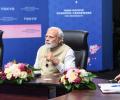
As US President Joe Biden launched a new trade deal with 12 Indo-Pacific nations, including India, to enhance trade, economic and investment opportunities, China, which sees the pact as a threat to its dominance in the region, went on the offensive against it, promising more opening up, while the official media here termed it as "economic Nato".

Trump's new rules for how countries should treat him have led to the current breakdown in India-US relations, explains Ambassador T P Sreenivasan.
Singapore on Wednesday said it was hopeful that a Free Trade Agreement with India would be signed by the middle of this year.

During his visit to India last year, Australian Prime Minister Tony Abbott had expressed concern over lack of growth in bilateral trade.
India and ASEAN are working on a list of items on which the two sides will bring down tariffs faster and implement it by January next year.

India and China on Monday decided to resume the Kailash Mansarovar Yatra as the two sides agreed to take certain people-centric steps to 'stabilise and rebuild' ties.

Russia's unprecedented rapprochement with North Korea has raised concerns about the re-emergence of a Russia-China-North Korea alliance which could increase the probability of conflict on the Korean Peninsula, explains Dr Rajaram Panda.

If Beijing succeeds in this multipronged effort to challenge the current dominant power, it will have not just economic but political and security consequences. There is no let-up in the South China Sea nor any de-escalation moves on the India-China border. This portends to ominous signalling from Beijing, observes China expert Srikanth Kondapalli.

We have nothing to gain by raising our concerns internationally as our narrative has got entangled with several controversial concepts in the United Nations, asserts Ambassador T N Sreenivasan.

During their talks, the two leaders decided to significantly expand their ties in several key areas including defence, trade, energy and education.

India, South Korea sign 7 agreements to boost cooperation.
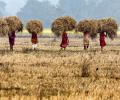
In a significant policy shift aimed at boosting agri-productivity and rural prosperity, Finance Minister Nirmala Sitharaman on Saturday announced six new agricultural schemes while increasing the subsidised Kisan Credit Card loan limit to Rs 5 lakh from the existing Rs 3 lakh, benefiting 7.7 crore farmers, fishermen, and dairy farmers.
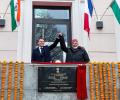
Prime Minister Narendra Modi and French President Emmanuel Macron have called for enhancing trade and investment ties between their countries and committed to further deepening their engagement in the Indo-Pacific. They discussed a full spectrum of bilateral relations, including key global and regional issues, and stressed the urgent need for reform in the United Nations Security Council. The leaders also underscored their commitment to ensuring the global AI sector can drive positive social, economic, and environmental outcomes.
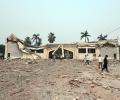
'Every decision India makes along the LoC, it must also consider implications along the LAC.'

The 2 countries signed 15 agreements including one on defence cooperation after Prime Minister Narendra Modi held 'productive discussions' with President Joko Widodo.

Many unauthorised migrants originate from Punjab and Gujarat, states known for high migration aspirations rather than political instability.
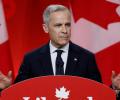
In a dramatic shift in Canada's foreign policy, Prime Minister Mark Carney on Thursday declared that the long-standing economic and security relationship between Canada and the United States has ended, responding to US President Donald Trump's announcement of new auto tariffs that could severely impact Canada's economy, Politico reported.

He also said that his country would continue to talk about the Kashmir issue "through channels that are acceptable" and prayed that "the issue is amicably resolved".

Countries that have signed the RCEP agreement can start negotiations with India for joining the pact once New Delhi submits a written request stating its intention for the same, according to a declaration. On November 4 last year, India walked out of mega free trade agreement RCEP (Regional Comprehensive Economic Partnership) as negotiations failed to address New Delhi's outstanding issues and concerns. The remaining 15 member countries have signed RCEP agreement and have stated that the pact would remain open to India.

External Affairs Minister S Jaishankar on Friday met Akie Abe, the wife of Japan's late Prime Minister Shinzo Abe and recalled the late premier's invaluable contribution to the advancement of India-Japan relations.
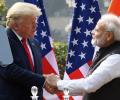
Prime Minister Narendra Modi and United States President Donald Trump on Monday vowed to work towards a 'trusted' partnership with a focus on boosting India-US cooperation in areas of trade, energy and defence in their first phone conversation since the American leader's inauguration last week.

After a fruitful visit of US President Barack Obama, India is planning to initiate negotiations for a Comprehensive Economic Partnership Agreement with the country.

Modi and Albanese also reiterated their shared ambition for an early conclusion of the ambitious Comprehensive Economic Cooperation Agreement (CECA) that is expected to significantly expand bilateral trade ties.
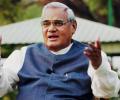
It was good fortune for India to have Atal Bihari Vajpayee lead the government at a crucial moment in our history. He avoided India meeting the fate of Iraq or Ukraine, asserts military historian Colonel Anil A Athale (retd).

Jaishankar said he was confident that Prime Minister Modi and President Putin will meet for an annual summit next year.

Modi thanked his Australian counterpart for supporting him in unveiling the foundation stone of 'Little India', a suburb of Sydney.
